
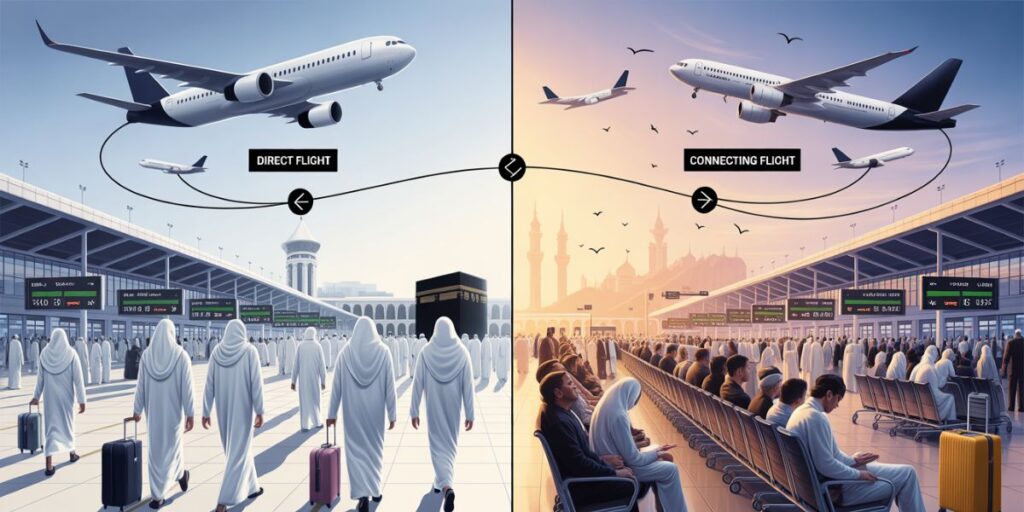
When you are planning a journey of a lifetime to Makkah and Madinah, every decision feels important. One of the first major choices you will face is how to get there. Choosing between direct flights vs connecting flights for hajj umrah is about more than just a ticket price; it is about managing your energy for the worship ahead.
The spiritual weight of Hajj and Umrah is immense. You want to arrive at the Miqat or your hotel feeling refreshed, not exhausted by a long journey. As we look at travel in 2026, the options have expanded, but the best choice still depends on your health, your group, and your budget.
We often see pilgrims struggle with fatigue before they even start their first Tawaf. This guide will help you weigh the pros and cons of each flight type so you can make the right choice for your spiritual path.
Understanding Direct Flights for Umrah and Hajj
A direct flight is exactly what it sounds like: you board the plane in your home city and land directly in Jeddah or Madinah. There are no stops, no switching planes, and no waiting in transit lounges.
This is often considered the best flight option for hajj and umrah because it is the most straightforward. For many travelers, especially those coming from major hubs like London, Dubai, or New York, a direct flight for umrah is the standard expectation.
Who Suits Direct Flights Best?
Direct flights are ideal for those who prioritize time and physical ease. If you are traveling with young children or elderly parents, reducing the number of take-offs and landings is a major benefit. It keeps the travel “story” simple and avoids the risk of getting lost in a foreign airport during a connection.
Understanding Connecting Flights for Hajj and Umrah
Connecting flights involve at least one stop in a different city. For example, you might fly from your home to Istanbul, Doha, or Cairo before boarding a second flight to Saudi Arabia.
These umrah flight options are very common because they often utilize major international airlines like Turkish Airlines, Qatar Airways, or EgyptAir. While they take longer, they are a staple of many umrah packages because they offer more flexibility in departure times and often come at a lower cost.
Layovers and Transit
The “stop” in a connecting flight is called a layover. These can range from a quick two-hour dash to a 12-hour wait. In 2026, many airports have improved their transit facilities, offering prayer rooms and Halal dining, making the wait more comfortable than in previous years.
Direct Flights: Pros and Cons
Choosing a direct route is a popular choice for a reason, but it does come with trade-offs.
The Pros
- Time Saving: You reach the Holy Cities in the shortest time possible. This is vital when you are trying to coordinate with the latest umrah visa updates regarding your entry window.
- Less Physical Fatigue: You only have to go through security and boarding once. This preserves your energy for the physically demanding acts of Sa’ee and Tawaf.
- Reduced Luggage Risk: Your bags stay on one plane. The chance of lost luggage is significantly lower on direct flights.
The Cons
- Higher Cost: Convenience usually comes with a higher price tag. Direct flights are almost always more expensive than those with stops.
- Fixed Schedules: Direct flights may only fly on specific days of the week, which might not perfectly align with your preferred hajj packages.
Connecting Flights: Pros and Cons
Connecting flights for hajj are the preferred choice for millions of pilgrims every year. Here is why they might or might not, work for you.
The Pros
- Budget Friendly: If you are looking to save money to spend on better accommodation in Makkah, choosing a flight with a layover is the best way to do it.
- Flexibility: There are hundreds of ways to get to Saudi Arabia via connection. You can find a flight at almost any hour of any day.
- A “Break” in the Journey: For very long-haul flights (over 10 hours), some pilgrims actually prefer a 3-hour layover to stretch their legs, pray in a quiet lounge, and walk around.
The Cons
- Increased Stress: Navigating a large airport like Istanbul or Dubai during a short layover can be stressful, especially if your first flight is delayed.
- Transit Visas: Depending on your nationality and the stopover country, you might need to check transit visa rules.
- Risk of Delays: Every connection is a chance for a delay. If you miss your second flight, it can throw off your entire hotel booking and transport schedule in Saudi Arabia.
Which Option Is Better for Elderly Pilgrims and Families?
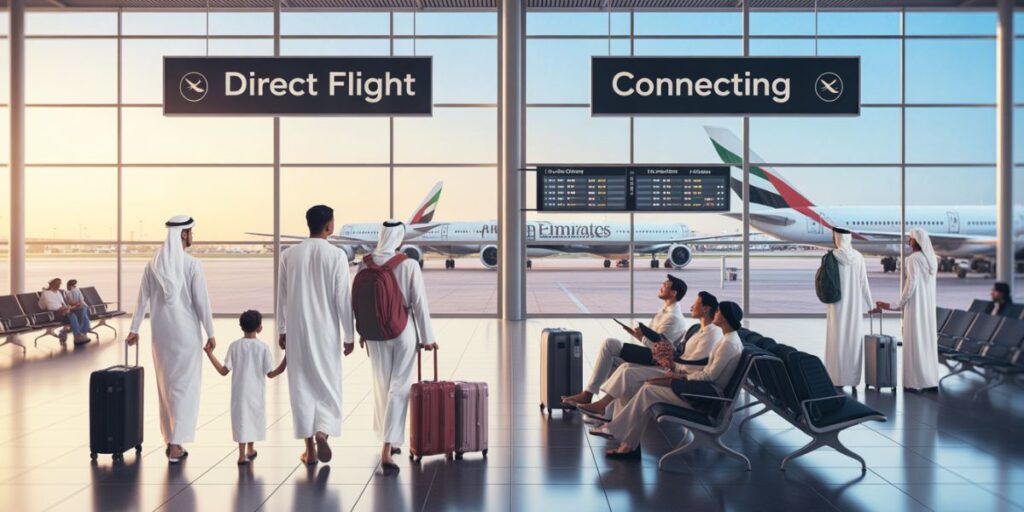
When traveling as a family, the “ease factor” should usually outweigh the “cost factor.”
For elderly pilgrims, we highly recommend direct flights. The process of getting off a plane, walking through a massive terminal, and waiting for several hours can cause swelling in the legs and general exhaustion. If you are a woman traveling in a group, our hajj guide for women emphasizes the importance of maintaining your energy levels.
Travel Tip for Families: If a direct flight is too expensive, look for a connecting flight with a “long” layover of 5–6 hours. This allows you to rent a transit hotel room or use a lounge where the kids can sleep properly and the elderly can rest their backs.
Which Option Is Better for Budget Travelers?
If you are a student or a young couple on a tight budget, connecting flights are almost always the winner. By choosing a flight with a stopover, you can often save enough money to upgrade your hotel from a 3-star to a 4-star closer to the Haram.
In 2026, keep an eye on “Transit Umrah” options. Some airlines now offer a free stopover visa if you fly with them, allowing you to perform a quick Umrah and then continue to your final destination. This is an excellent way to see more of the world while fulfilling your spiritual duties.
Travel Tips to Avoid Flight Stress
Regardless of which direct flights vs connecting flights for hajj umrah choice you make, these hajj umrah travel tips will help you stay calm:
- Check Your Miqat: If you are flying directly into Jeddah to perform Umrah, you will likely cross the Miqat in the air. You must be in Ihram before the plane reaches that point. Connecting flights often make this easier because you can change into your Ihram during the layover at the airport.
- Pack an “Essentials” Carry-on: Always keep your medications, a change of clothes (including Ihram), and your Complete Umrah and Hajj Preparation Guide for Pilgrims in your cabin bag. If your checked luggage is delayed on a connecting flight, you can still proceed with your Umrah.
- Use Airport Apps: Download the app for your transit airport. It will give you real-time gate changes and maps so you don’t feel lost.
How Flight Choice Affects Your Overall Experience
Your flight is the “preface” to your pilgrimage. If the journey is chaotic and exhausting, you may spend your first two days in Makkah sleeping instead of praying.
A smooth arrival allows you to enter the Masjid al-Haram with a clear mind and a focused heart. When choosing your transport, think about how you want to feel when you first lay eyes on the Kaaba. Do you want to feel tired and frustrated, or calm and ready?
Choosing What Fits Your Peace of Mind
At the end of the day, there is no “perfect” flight, only the flight that is perfect for you.
- Choose a direct flight if you have the budget and want to prioritize the comfort of the elderly and children.
- Choose a connecting flight if you want to save money, have more date options, or need a break on a very long journey.
At Three N Travel & Tourism LLC, we always advise our pilgrims to choose the path of least resistance. Hajj and Umrah are already tests of patience; you don’t need to test yourself with a difficult flight if you don’t have to.